
Chelmsford Address Records by Era
One address often needs several record systems. The Registry preserves transfer history, printed directories and Lists of Men and Women can place households at a date, and reports or vital sources may help explain an interval. Each source answers a narrower question. A deed may identify parties to a transfer, not an occupant. A directory can record a household listing, not a legal title. Start with the era that is actually in question, then add only sources that can support it.
| Source | Years It Covers | Where Held | What It Shows |
|---|---|---|---|
| Registry computerized recorded-land index | 1976–present in detailed instructions | Masslandrecords and Middlesex North Registry | Recorded documents, parties, dates, book/page, and instrument references |
| Unindexed Middlesex North books | 1855–1949 | Registry book/page route | Earlier page images when the computerized index does not reach the period |
| Copied Cambridge/Middlesex South books | Before 1855 | Registry town/book/page route | Earlier town-separated deed material |
| Directories and Town Book | 1896–2022, irregular runs | Library and Historical Society collections | Dated household and street clues |
| Lists of Men and Women | 1931–2009, with gaps | Local collections; later volumes through Town Clerk | Alphabetical and by-street listings for applicable volumes |
| Town reports and federal census | 1875–present; census public through 1950 | Town, Library, and library database routes | Administrative snapshots and dated household context |
The era worksheet also includes Massachusetts Archives vital records for 1841–1935 and cemetery records with varying historical depth. Use exact source years or a live portal-capture date in research notes.
Chelmsford Address Records Before Numbers
Address research in Chelmsford has a local break point. The Historical Society's Property Research How-To says house numbers were not generally assigned until the early 1940s. Lists of Men and Women have no street numbers until 1942. An older entry may therefore need a street, village, household name, and nearby listings before it can be compared with a modern address.
Preserve printed forms such as RD, NC, W, EC, h do, r, or a shortened street name. Put any modern interpretation in a separate note. The same guide warns that a road spelling can need alternate search keys, and the Stedman or Steadman material flags a town GIS spelling issue and a same-name road over the town line. Postal ZIP, precinct, street label, and village name are different fields, not interchangeable proof.
Note: Early Chelmsford records need address normalization before comparison, especially when a printed entry lacks a number or uses a village abbreviation.
Chelmsford Registry Records Routes
The Middlesex North Registry instructions provide the backward route. For computerized recorded land, narrow a name or property search with Chelmsford when the town filter is available, then record the document type, date, parties, book/page or instrument number, legal description, plan reference, and image citation. Search street names without suffixes if a variant interferes. Condominiums may use a unit, and hyphenated or numeric street forms can index more than one way.
The detailed instructions state computerized recorded-land name coverage from 1976 forward. The Registry FAQ says 1966 forward. That discrepancy should be logged, not silently solved. Use the detailed-instructions date for the workflow, test the exact document period, and move to the older routes if there is no result. The Registry says deeds from 1629 onward are scanned online, but access mechanics change by era.
Open the Middlesex North historical grantor/grantee search before beginning an older chain.
The Registry landing route is the starting point for choosing the correct historical range and for separating a name index from a property or book/page search.
Chelmsford Deed Chain for Past Owners
A chain of title is the documented sequence of transfers for a parcel. Begin with a current assessor or GIS reference, then use the recorded document to move backward. In a purchase deed, the buyer is the grantee and the giving or selling party is the grantor. The seller's earlier acquisition often supplies the next link. A street address helps orient the search, but the legal description and book/page references become more important as the chain moves into older material.
- Use the Vision Government Solutions Chelmsford assessor database or Town GIS to record the current parcel identifier and location carefully.
- Find the relevant recorded deed in the Middlesex North index and note its recording date, parties, document type, book/page or instrument, town, and legal description.
- Search the grantor from that deed as a grantee in an earlier transaction, then compare the parcel description and references.
- Repeat the documented links backward, marking name changes, trusts, estates, and uncertain parcel matches rather than forcing a connection.
- When the chain reaches an older gap, use book/page for the 1855–1949 unindexed books or town/book/page for pre-1855 copied records.
- Grantor / grantee
- The party giving or selling an interest, and the party receiving it. The terms identify a transaction role, not residence.
- Chain of title
- The sequence of recorded transfers connected by document citations and parcel descriptions.
- Legal description
- The recorded parcel wording, plan, or lot reference that can remain useful when street forms change.
Chelmsford Recorded-Land Index Gaps
Older Registry research has a distinct fallback path. Pre-1976 grantor and grantee indexes let a researcher choose a range such as 1620–1855 or 1856–1880, enter a last and first name, and inspect index images. A page may show only the first name at a time, so adjacent alphabetic images may be necessary. Spelling and page boundaries need image verification.
The unindexed property search covers books 1 through 1131, from 1855 through December 1949, by book and page. Pre-1855 material is copied older Cambridge records divided by town after 1855. An even-page selection may require the next odd image because of the Registry's facing-page landscape layout. These are normal access quirks, not evidence that a property history ends.
Plans can also matter. Record the plan book/page or plan number, date, road layout, lot references, and public surveyor or owner names where shown. Registered land has a separate certificate-title process and should never be merged with recorded-land deeds without a label.
Chelmsford Address Records in Directories
Deeds trace transfers. Dated household sources supply a different layer for past residents. The 1940–41 Polk directory can show a surname group, spouse marker, printed occupation, street or road, village abbreviation, and telephone marker, but entries may lack a number or point to another household member. The historical collections, publishers, and access routes are described in the Chelmsford city directory collections.
Use each printed form as evidence from that year. Pair a directory year with an available federal census year, annual report, obituary, cemetery result, or town record. The Library notes local newspaper microfilm for Chelmsford Independent from 1986 forward and Chelmsford Newsweekly from 1940–1993, while full-text and paid/in-library collections have their own date limits. Cite a page or issue, not just the publication title.
- Copy the directory title, date, page, exact name form, street expression, village mark, and any printed household clues.
- Check the closest earlier and later surviving directory or List of Men and Women, allowing for gaps in the sequence.
- Compare the dated address clue with the correct public census year, without treating the census as a current address record.
- Use a cemetery, obituary, vital, or probate route to test a departure or family event, then label the type of evidence.
Chelmsford Address-Record Research Models
The Town's Historic Records route provides annual reports from 1875 forward and selectmen minutes from 1898–2010. A dated report can add road, board, school, or vital-statistics context to a place. It cannot by itself establish that a particular family lived at a specific address. The Town Historic Records page is a practical route to these municipal sources.
The 227 Groton Road Massachusetts Historical Commission Form B offers a local model of a careful source stack. It combines town registrar lists, assessor information, several city directories, deeds, aerials, census years, cemetery material, plans, and Route 3 records. That combination shows why a single database result is rarely a full address history. It is a documented example, not a pattern that should be imposed on every Chelmsford address.
View the Registry genealogical-research guidance for its explanation of index parties, brief property descriptions, book/page references, and title-reference paragraphs.
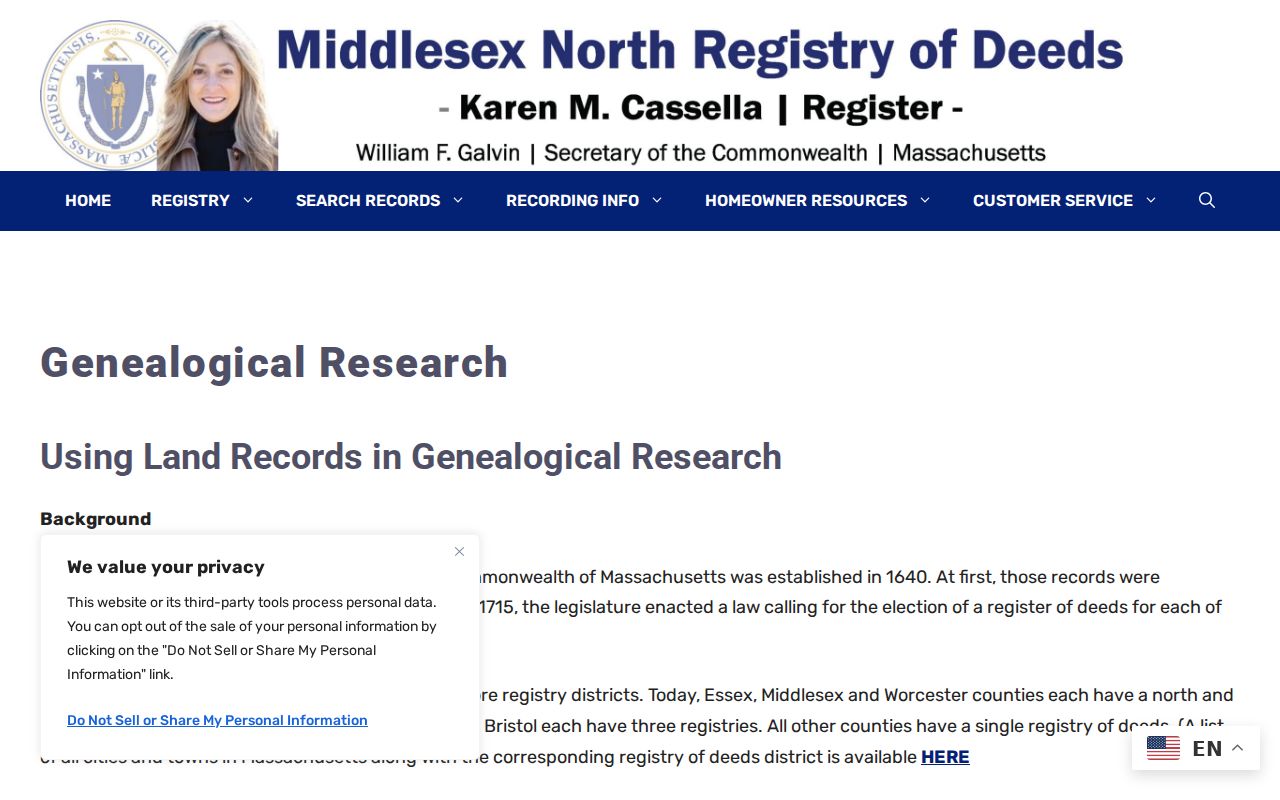
The guidance emphasizes a citation-based backward chain, which helps distinguish a supported transfer history from a loose collection of matching names.
Chelmsford Address-Record Trail Endpoints
When a household trail reaches a death, marriage, or birth event, use the channel that matches the event and year. Chelmsford's local route has its own event-jurisdiction rules. Massachusetts Archives holds statewide records from 1841–1935, and its research requests, certified-copy form, email, mail, and in-person routes have separate rules. Earlier Chelmsford material can be checked against the historical vital-record volume through 1849.
Town cemetery records are another dated lead. The burial portal accepts names, aliases or maiden names, and date or year ranges, and can show similar matches. Probate files can add a case trail when public access permits, but a case name or a probate party does not prove residence. Keep the record type and limitation beside the finding.
Note: A deed, directory, cemetery entry, and vital record can reinforce one another, but each remains evidence of its own date and purpose.
Chelmsford Address-Records Limits
House-history research should stay focused on historical, family, estate, and local-history questions. Suppressed addresses and confidential voter material must remain protected. A public mailing address can be a tax, trustee, corporate, or stale address, and it is not proof that someone lived at the property. The Registry's free copy supports research, while a certified copy is the formal-copy route when one is needed.
For a record that is not online, use the Library appointment, Town Clerk or Cemetery counter, Registry, courthouse public terminal, public-record request, or State Archives route documented for that record type. A negative search is a limitation of the sources checked, not proof that no person ever lived there.