
Chelmsford Historical City Directory Collections
The strongest planning source is the Chelmsford Historical Society directory inventory. It identifies real gaps as well as the runs that survive. The Library's Local History Room and Historical Society holdings make a historical directory useful even when a volume is not online. Some material is digitized through Internet Archive, while other volumes are best handled in person. Treat a supplier notation in the inventory as access provenance, not proof that the supplier created the original book.
| Collection | Years | Where Held | Access |
|---|---|---|---|
| Meek directories | 1896–97, 1898–99, 1911, 1913–14, 1915–16, 1917–18, 1919, 1921, 1925–26 | Historical Society inventory and local collections | Check the listed holding before a visit |
| Simpson-Murdock and Miller volumes | 1900–01, 1905; 1930–31 | Historical Society inventory | Local-history planning source |
| Polk directories | 1932–33 through 1990, in irregular runs | Library, Historical Society, and selected digital access | Compare the exact edition |
| Lists of Men and Women | 1931; annual 1939–1977; 1978–2000 except 2001–03; selected 2004–09 | Library and Historical Society | Later lists may be viewed at the Town Clerk office |
| Town Book | 1993–94, 2006, 2010, 2012, 2014, 2016, 2018, 2020, 2022 | Historical Society inventory | Year-specific access |
Those intervals do not form one unbroken sequence. A missing year can mean a different publisher, an unlisted volume, or no surviving item in the stated inventory. Record the title, year, and page before drawing a conclusion.
Chelmsford Historical Directory Shelf
The Chelmsford Library Local History Room is in the lower level of the Main Library at 25 Boston Road. Its materials do not circulate. Appointments are available during open hours through Meeting Rooms or by calling 978-256-5521 extension 1211. That local route matters when a searchable scan has poor text recognition, when an abbreviation key needs inspection, or when a particular year is not digitized.
Library access has useful limits. American Ancestors and Ancestry Library are in-library resources, while FamilySearch Affiliate access is at the reference desk. The genealogy guide also points to yearbooks, cemetery material, directories, and local newspaper resources. A remote search result and an in-library source are not interchangeable.
See the Library genealogy and obituary resources before choosing a visit date.
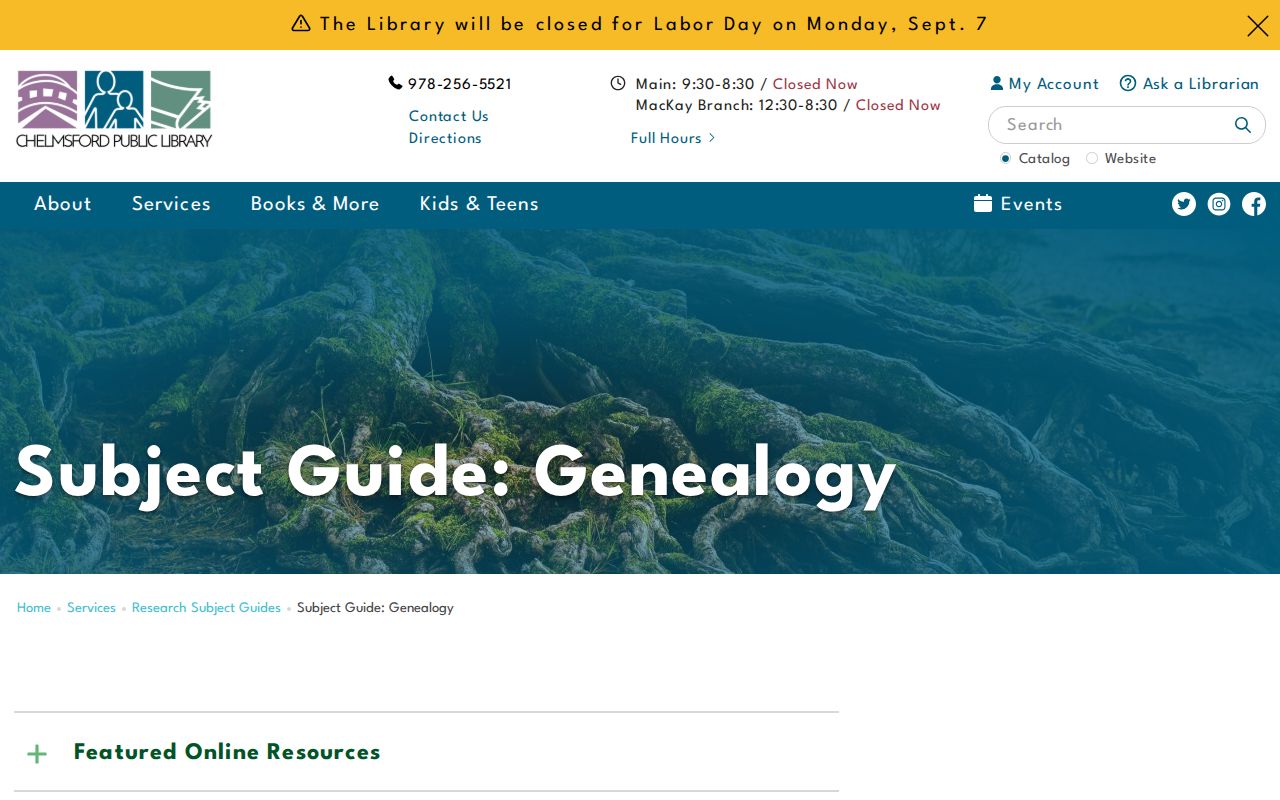
The library resource view helps connect a directory year to companion material such as obituaries, yearbooks, cemetery records, and reference-desk assistance.
Polk Clues in Chelmsford Directories
The inspected 1940–41 Polk volume shows why a historical volume is more than a name list. Its visible entries can group a surname with a given name and middle initial, show a spouse in parentheses, print an occupation, give a street or road, include a village mark such as NC, W, or EC, and sometimes show an exchange-style telephone marker. It also includes a deceased notation in at least one inspected entry. These are printed clues, not modern contact facts.
Household structure deserves a slow read. An entry can point to another household member with a printed mark, use a short road form, or omit a house number. Preserve the spelling and punctuation from the page. Do not expand a village abbreviation or an h/r marker unless that edition's key supports the meaning. The directory holdings inventory is the best place to select a second year for comparison.
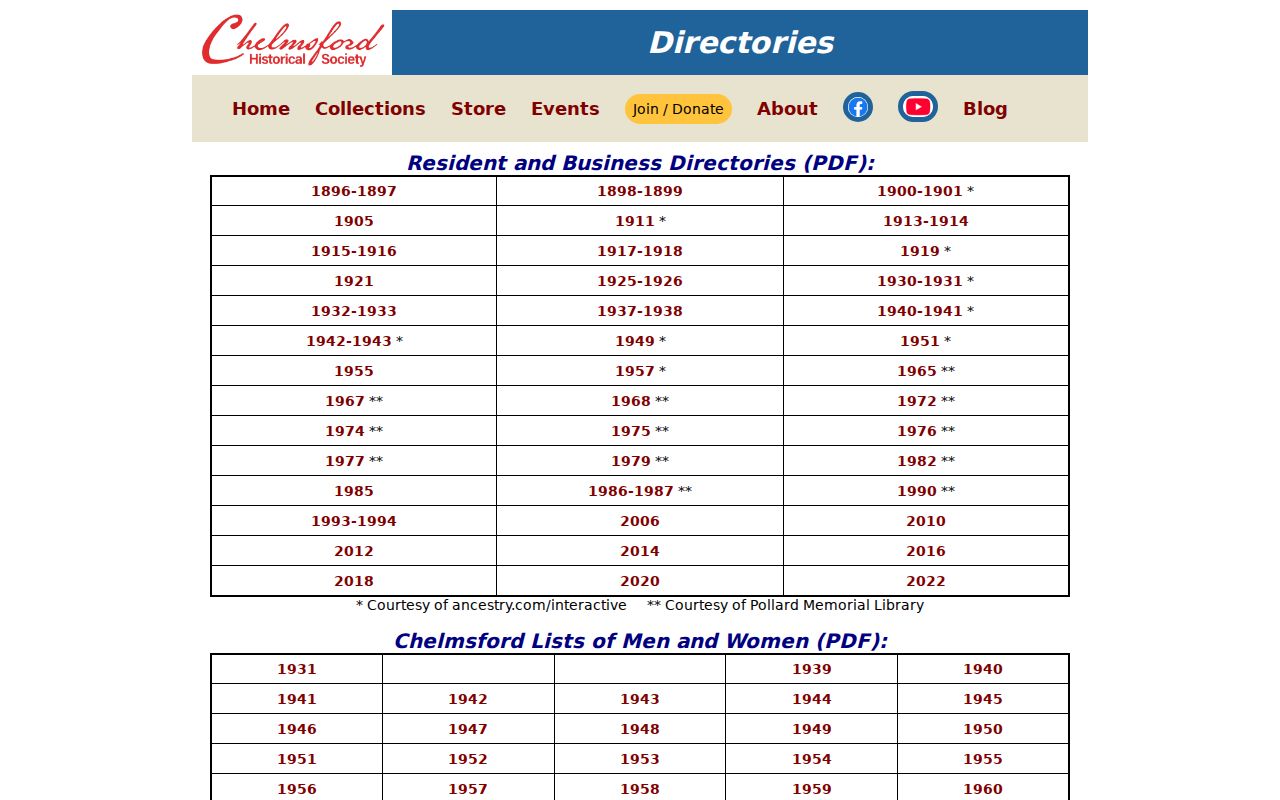
The holdings list makes the irregular sequence visible, so a researcher can test a name before and after a gap instead of treating one volume as a complete timeline.
Note: A historical entry can document a dated printed listing, but it does not confirm a person's present address or contact information.
Chelmsford Historical Directory Gaps
Publication changed hands over time. Meek, Simpson-Murdock, Miller, Polk, Town Book, and Lists of Men and Women each follow their own schedules. The Town's Historic Records route adds resident lists from 1896–1967, selectmen minutes from 1898–2010, annual reports from 1875 forward, and election material. These sources can provide context when the directory sequence is thin, but they are not replacements for a missing directory page.
Annual reports are especially useful for the public setting around a date. They can show boards, roads, schools, vital-statistics summaries, and municipal activity. Cite the exact report year and page, because the Library mentions reports from 1874 while the Town historical page states 1875 forward. Both statements describe access routes, not a reason to flatten the date range.
Reading a Chelmsford Directory Entry
Read the full line before recording any field. The 1940–41 sample shows that format varies within one book. Some entries carry a spouse name, some identify a student or a deceased person, some use a rural-route or village marker, and some include a number. A field that is absent should stay absent in notes. Do not manufacture a full street address or identify a relationship that the printed line does not state.
| Name group | Surname, given name, and sometimes a middle initial or a related household entry |
|---|---|
| Spouse clue | A name may appear in parentheses when printed in that edition |
| Printed occupation | A historical descriptive field, present for some entries and absent for others |
| Street expression | A road, short street form, rural-route form, or occasional number |
| Source marks | h/r, village labels, telephone markers, or notations that need the volume's own key |
- Criss-cross directory
- A street-ordered directory that can connect an address to printed household listings when the volume actually has that arrangement.
- Householder index
- An index arranged around the listed household, useful for moving from a surname to the full printed entry.
- Abbreviation key
- The edition's explanation of its own short forms. Photograph or transcribe it before interpreting a mark.
Chelmsford Directory Companions
Use a directory alongside sources that answer a different question. Chelmsford Historical Society yearbooks run from 1925 through 2026. The Library also identifies cemetery spreadsheets, obituary help, FamilySearch, Newspapers.com, Fold3, and other reference tools with access conditions. A newspaper can add a date or organization reference; a cemetery entry can support a death-date lead; neither turns an old directory address into current information.
For vital-record research, route by event and date. The Massachusetts Archives covers statewide vital records from 1841–1935, while earlier Chelmsford material is represented by a historical volume based on town records, church registers, cemetery inscriptions, and other sources. It is valuable genealogy evidence, not a modern certified record.
Open the digitized Chelmsford vital-records volume through 1849 when the directory trail reaches before the later collections.
The book provides an earlier reference layer that can be paired with town records, cemetery evidence, and later directory years.
Tracing Chelmsford Historical Directories
A sequence works best when each observation stays tied to the volume that supplied it. Begin with the exact spelling in one entry. Check an earlier and later available year. Then compare the printed street, village term, spouse clue, and household markers. Federal census schedules are a separate, date-bounded source: the 1950 census is public under the 72-year release rule, while later schedules are not yet public as of the research date.
- Choose one dated directory entry and copy its title, year, page, spelling, and printed address form.
- Check the closest earlier and later available Chelmsford directory volumes, allowing for publisher gaps.
- Keep the original street form and village label, then make a separate normalization note only if another source supports it.
- Pair the directory period with an available census year or a dated town list, noting the source's different purpose.
- Use an obituary, cemetery record, annual report, or vital-record route to test a departure, death, or family event.
A name disappearing can reflect a move, death, changed listing style, unprinted year, or a household arrangement not obvious from the page. Mark the result as unresolved until a second dated source supports an explanation.
Chelmsford Directory Time Markers
The historical shelf has several useful time markers. Chelmsford's inventory begins with Meek volumes in 1896–97, moves through additional publishers and Polk issues, and reaches selected Town Book editions in 2022. Lists of Men and Women span 1931 through selected 2009 volumes, with the Society noting Town Clerk viewing for lists from 2010 forward. That changing format is a feature of the record trail, not an error to erase.
- 1896–97: the first Meek volume listed in the Historical Society inventory.
- 1931: a listed edition of Lists of Men and Women begins a separate series.
- 1940–41: the inspected Polk edition preserves grouped household and village markers.
- 2010 onward: the Society directs researchers to the Town Clerk for later Lists of Men and Women.
Chelmsford Directory Limits
Directory research is strongest when it is modest. A listing is evidence that a publisher printed particular information at a stated time. It is not a present-day locator, a complete household roster, or proof of ownership. Middlesex North deed records can help test a parcel transfer, but a deed party is not automatically an occupant. For a modern name question, use an official record appropriate to the date and keep protected information suppressed.
Massachusetts maintains an Address Confidentiality Program, and protected voter or address records may not appear in ordinary public access. Use historical materials for family history, local history, and careful personal research. Repeated unwanted contact, threats, monitoring, or address exposure can cause harm and may be unlawful.
Note: Write down the source limitation with every finding, especially when an old street, spelling, or household mark cannot be verified.