
Finding Chelmsford Resident Records
Chelmsford resident research works best as a short chain, not a single name search. Start with an address when one is known. The town assessor and GIS can connect it to a parcel and its recorded owner. A historical household needs a different path: use a directory or List of Men and Women, then compare an adjacent year, a town report, a cemetery entry, or a vital-record route. A deed proves a recorded transfer, not daily occupancy. A directory shows a listing at a point in time, not current contact information.
For a current question, separate the parcel location from any mailing address and treat both cautiously. For a past question, preserve the printed spelling and village marker before trying to normalize it to a modern street. Chelmsford house numbers were not generally assigned until the early 1940s, so an early entry may require a street, village, household, and nearby listings to identify the right place.
- Use the town map or assessor record to establish the parcel and the exact address form.
- Check the Middlesex North index for a recorded instrument, book and page, or plan reference.
- Match a historical household with the closest directory, annual report, cemetery, or vital source.
- Use the Town Clerk or the right records access officer when an existing town record is not online.
Note: A source can support a dated listing or transaction without proving present residence, identity, ownership, or a right to contact anyone.
Chelmsford Records Office Routes
Most local directory trails pass through three separate custodians. The Middlesex North Registry of Deeds serves Chelmsford even though its office is in Lowell. The assessor database supplies parcel context. Election records and Town Clerk material follow their own access rules. Middlesex County government was abolished in 1997, so a general county clerk is not the route for every local question. Choose the custodian by record type instead.
Chelmsford Assessors
Town Offices, 50 Billerica Road
Chelmsford, MA
978-250-5220
Chelmsford Town Clerk
Town Offices, 50 Billerica Road
Chelmsford, MA
978-250-5205
Lowell court and Registry locations are service locations. They do not turn a Chelmsford address or a party in a record into a Lowell residence.
Chelmsford Parcel Search Fields
The town property-information page routes to the Vision assessor database and MapGeo. The assessor landing describes the FY2026 cycle and tells users to enter the online database. A parcel card can show a property identifier, street location, owner or taxpayer name, a separate mailing address, assessed values, land area, building details, sales history, and tax information when those fields are displayed. The card is a record snapshot, not a survey or an occupancy statement.
| Visible field | Careful use |
|---|---|
| Address or parcel ID | Anchor the search to the right Chelmsford parcel. |
| Owner and mailing address | Separate tax-mail routing from residence evidence. |
| Sale date and price | Use it to locate a deed, then inspect the recorded image. |
| Building and land facts | Use as property context, subject to the displayed date. |
The Chelmsford assessor landing establishes the official entry point before a reader moves from an address to the detailed database.
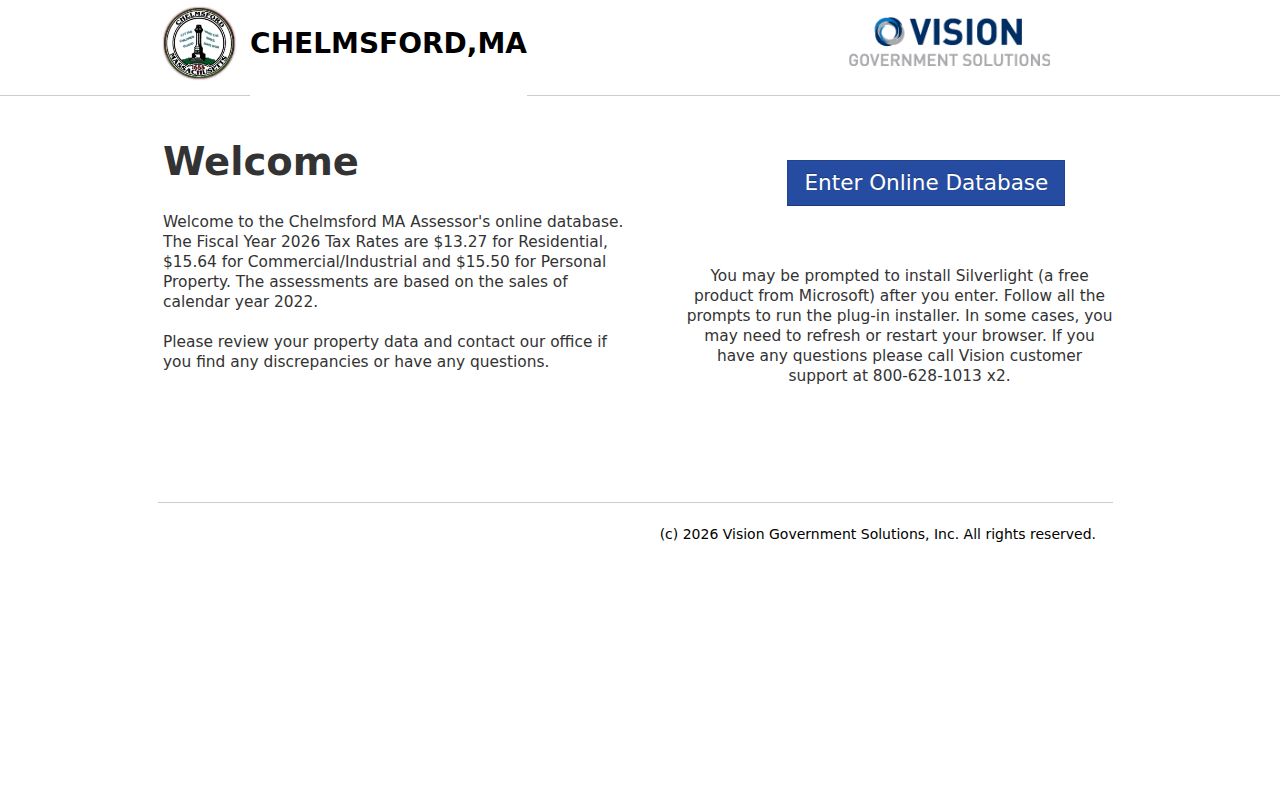
Use the displayed assessment cycle as context, then confirm the specific card's fields and date before relying on it.
Chelmsford Map and Address Clues
MapGeo accepts a map-block-lot number, address, or owner last name. Its result view can show lot lines, structures, adjacent parcels, and basic property data. Its themes include site details, natural resources, adjacent land use, zoning, and aerials. The town permitting guide calls the map general information, not an engineering or permitting document. That distinction matters when a boundary, road layout, or adjoining parcel needs a formal record.
The official Chelmsford MapGeo viewer gives the clearest first look at a parcel's map setting. A parcel boundary can guide a deed or plan search without becoming a list of people near that parcel.
Map and assessor sources work together: use the map for geographic context, then verify a selected parcel in the assessor record.
Chelmsford Deed Index Trail
Recorded land is the strongest local transaction trail. The Middlesex North computerized search supports name, book and page, document, property, and recorded-date searches. Detailed instructions describe the name index as 1976 to present, while a Registry FAQ says 1966 to present. Keep that discrepancy in a research note rather than assuming a missing record is conclusive. Property searches work best with Chelmsford selected when available, with street suffixes removed if variants interfere.
For older work, grantor is the party giving or selling an interest and grantee is the party receiving or buying it. The index can lead to an image, but the image, book/page, date, document type, town, parties, plan reference, and legal description are the useful evidence line. A legal description identifies the land in the instrument; it often survives street-number change better than an address.
The Middlesex North recorded-land search screen is an official route for the current index.
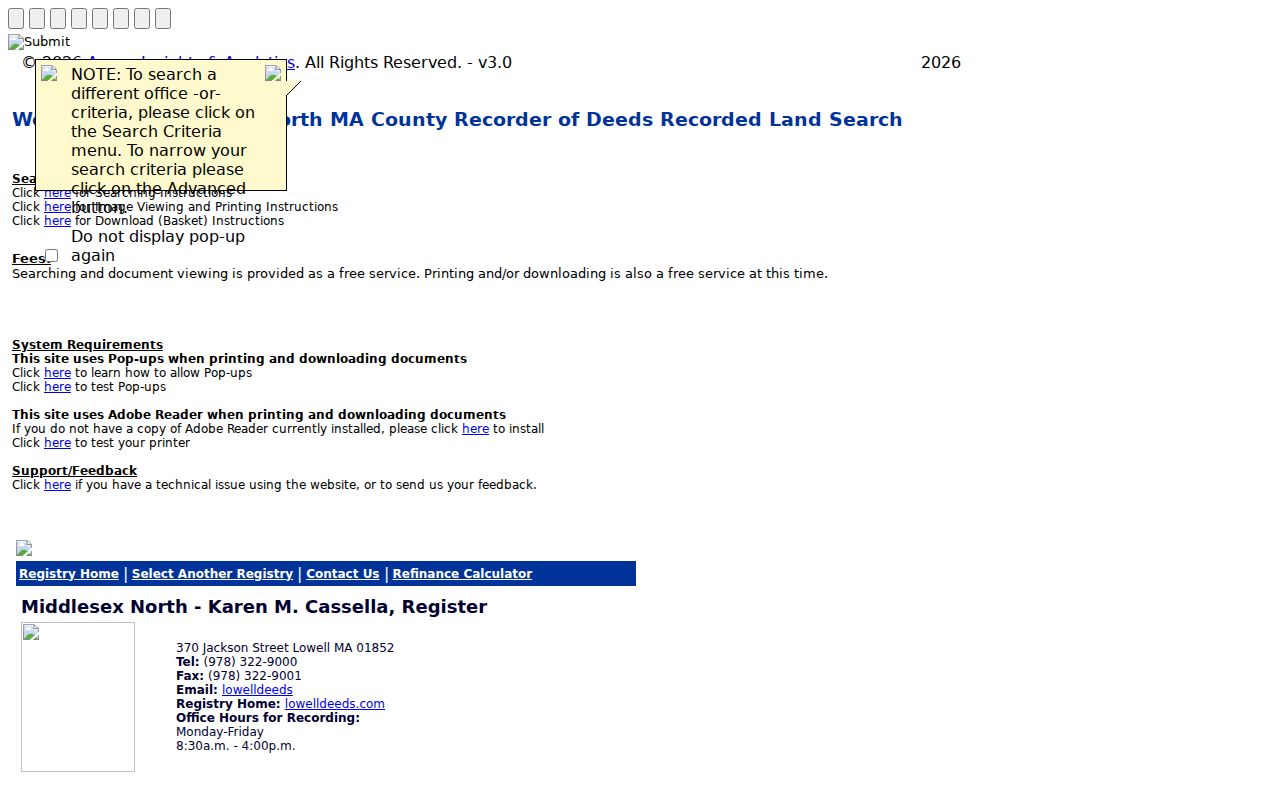
If the online property search fails, use book/page, date, spelling, or grantor-grantee fallbacks instead of treating the first result page as the whole chain.
Current Chelmsford Resident Sources
There is no one current public roll for every Chelmsford household. The directory-like sources below answer narrower questions. The municipal street list and voter file have protected fields and suppression rules. The state self-lookup is for an individual checking that person's own registration, not a public person finder. A public file request belongs with the local election office and should seek only public, segregable fields.
| Local source | What it can document | Custodian | Access path |
|---|---|---|---|
| Assessor parcel card | Parcel, owner/taxpayer, assessment context | Chelmsford Assessors | Online database or Assessor RAO |
| Street list | Date-specific resident listing, subject to protection | Town Clerk | Request; listed fee is $25 |
| Recorded land index | Parties to a recorded instrument | Middlesex North Registry | Online index and copy channels |
| Annual census | Period-of-residency update | Chelmsford Town Clerk | Town process, not voter proof |
For a name that must be matched across sources, the Chelmsford resident lookup route keeps the record types separate before a conclusion is made.
Chelmsford Voter Record Limits
Massachusetts voter access has two different channels. The public self-lookup requires first name, last name, date of birth, five-digit residential ZIP, and consent, and is meant for a voter to check that voter’s own status. Separately, state guidance says a local voter record may have public fields such as name, address, party, status, and registration information, while phone, email, confidential records, and protected information are not public in the same way.
The Massachusetts voter self-lookup is illustrated here with its blank form rather than a submitted person's record.
Address confidentiality and protected voter status can lawfully suppress a record, so absence from a result is not proof that information is wrong.
Chelmsford Public Records Requests
When an existing town record is not online, use the Massachusetts Public Records Law, MGL c.66 and c.4, §7(26). Chelmsford says a municipality generally responds within 10 business days by providing access or copies, or by explaining a delay or denial. Ask for an existing record, not a new research compilation. A focused request should name the department, record type, date range, address or parcel, preferred format, and whether inspection or copies are wanted.
The town's public-records law page identifies department-specific records access officers and points to the request portal. It also distinguishes vital records, which use their own request process.
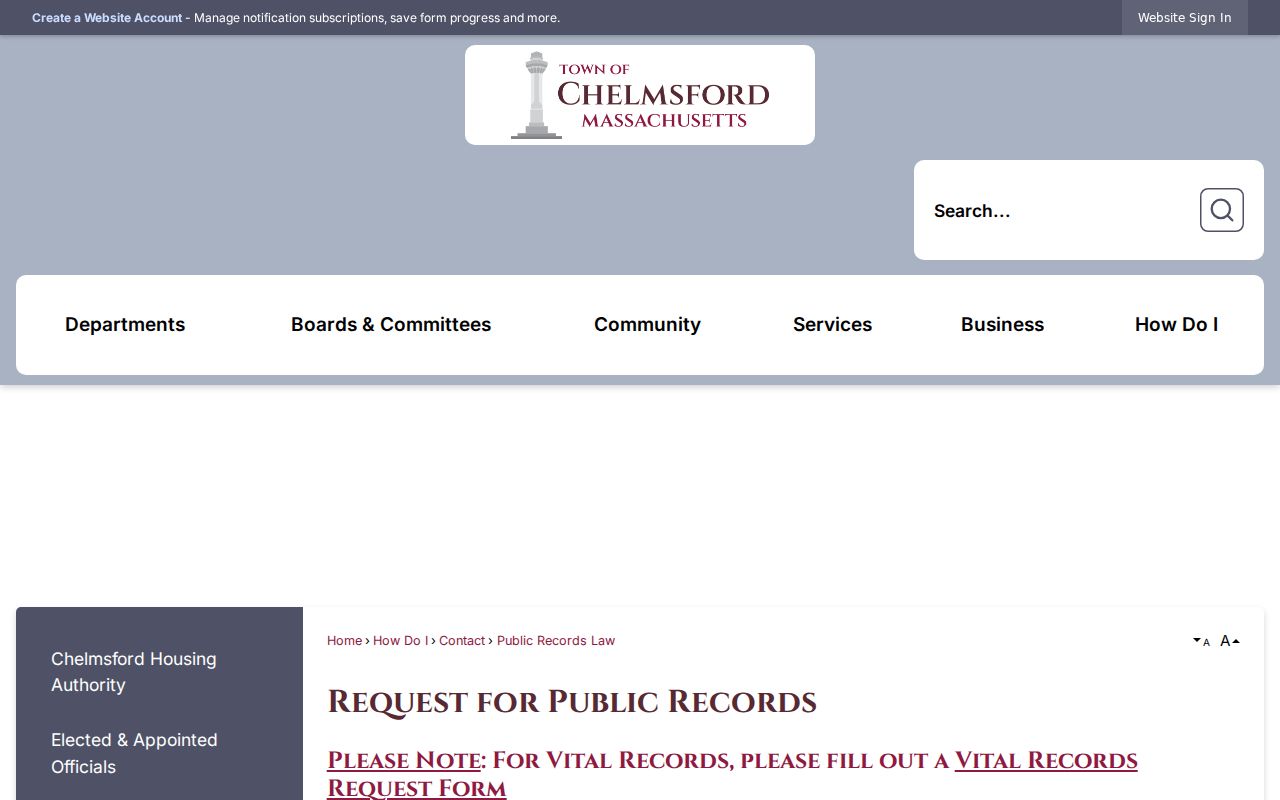
The state public-record request guidance gives the broader Massachusetts process and explains the records-access context behind a town request.
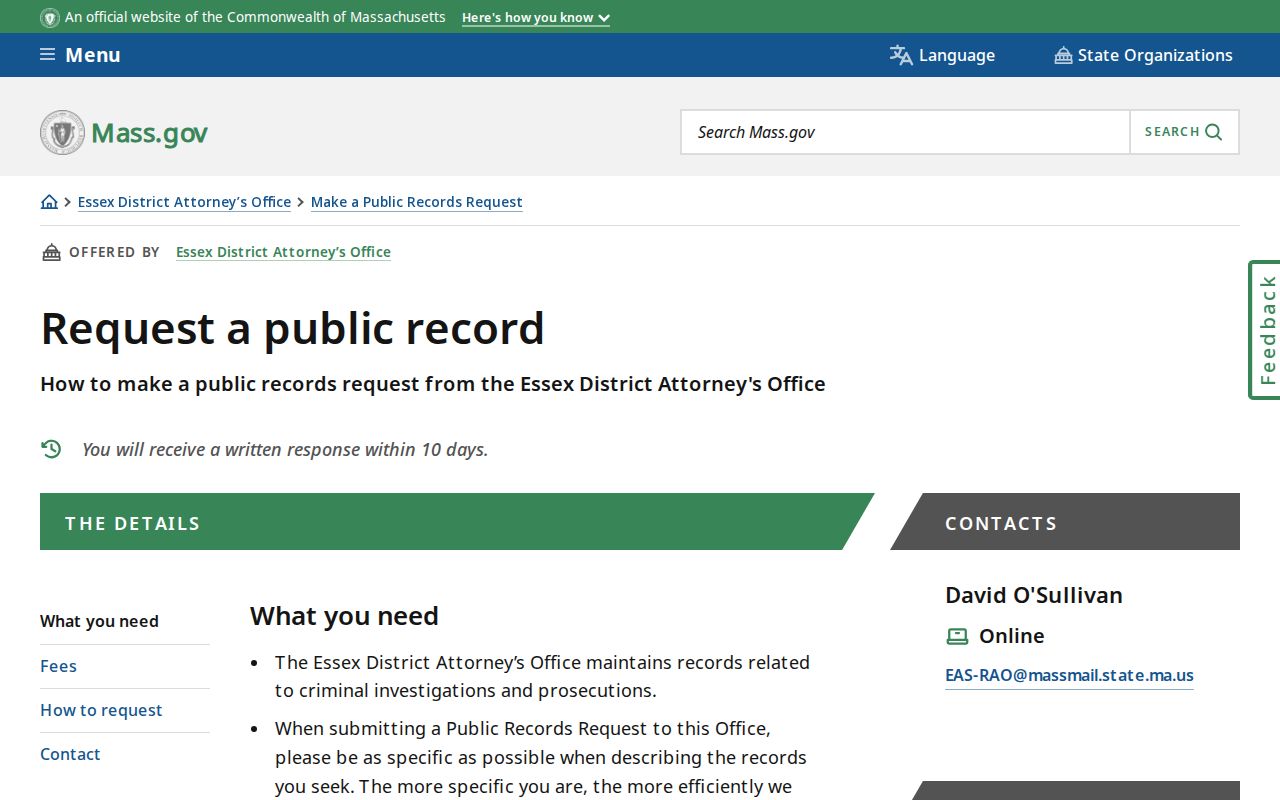
A narrow request for a street segment, year, or known instrument is more useful than asking an office to decide who lived somewhere.
Chelmsford Request Portal Options
The Town links its non-vital request process to an online form. It is one channel among several: requests may also go by mail, email to the relevant officer, fax, or in person at Town Offices, 50 Billerica Road. Assessor material belongs with the Assessor RAO; permit and application files go to Building or Community Development; cemetery records go to the cemetery route. Court files and Registry records use their specialized custodians instead.
The Chelmsford public-document request portal displays the submission fields for a records request.
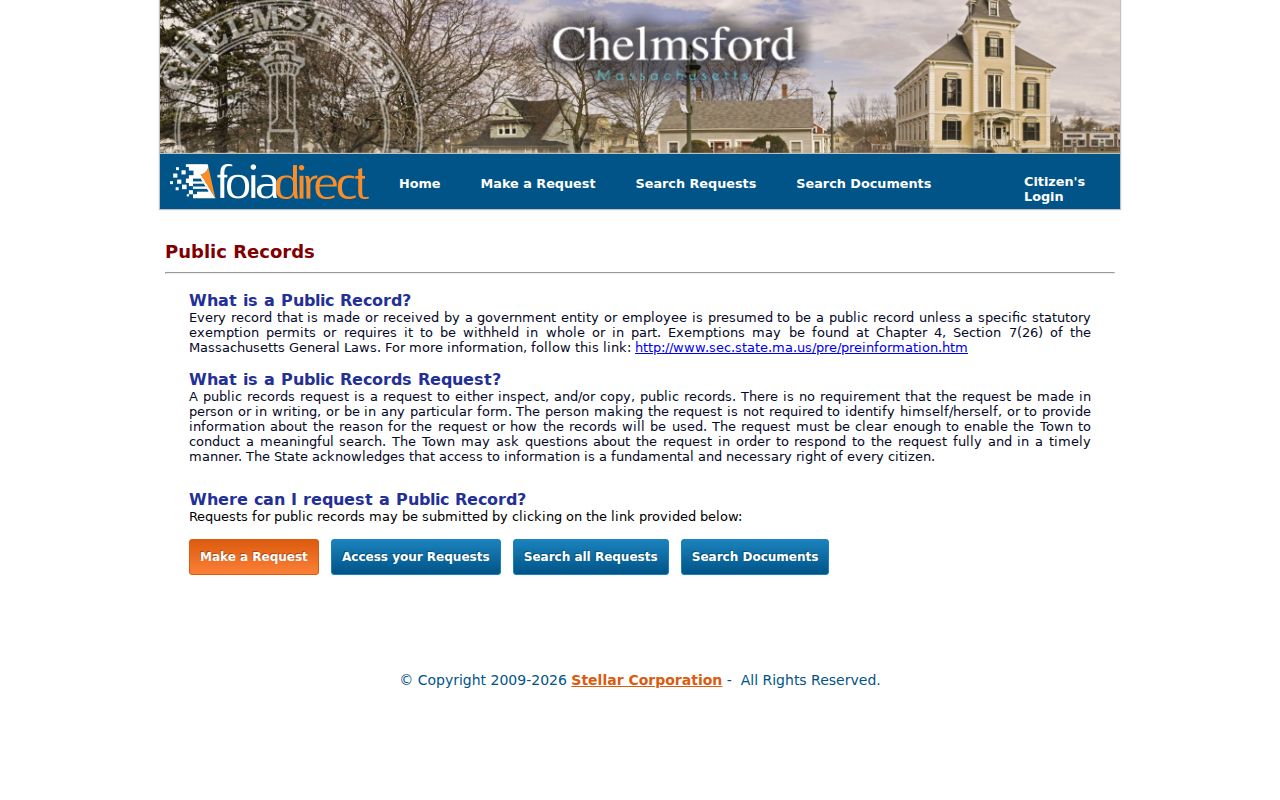
Request descriptions should include alternate spellings where known and ask for any nonexempt portion if a file needs redaction.
Note: Vital certificates use the Town Clerk or state process rather than the general Chelmsford records portal.
Chelmsford History Room Sources
Chelmsford Library's Local History Room is the main in-person fallback for resident lists, directories, reports, newspapers, cemeteries, and local history. It is in the lower level of the Main Library and materials do not circulate. Appointments are available during open hours through Meeting Rooms or 978-256-5521 x1211. The library genealogy guide also explains which databases require a library terminal, including American Ancestors, Ancestry Library, FamilySearch Affiliate access, Newspapers.com, and Fold3.
The Chelmsford history collection is the right route when an online index ends. Its shelves can link a printed listing to annual reports or newspapers without presenting a historical entry as current contact data.
- Roll
- A list compiled for a particular public or organizational purpose, with its own coverage and exclusions.
- Index
- A finding tool that points to a record or image; it is not necessarily the full record.
- Parcel
- A defined piece of land used in assessor and map records.
- Criss-cross directory
- An address-arranged directory, when a volume is actually arranged by street.
Historical Chelmsford Directory Runs
Historical Chelmsford directories are irregular, but unusually rich. The Historical Society lists Meek volumes from 1896–97 through 1925–26, Simpson-Murdock volumes for 1900–01 and 1905, Miller for 1930–31, a broad Polk run, later Town Books, and Lists of Men and Women on a separate schedule. The Town's historic-record material also links resident lists, annual reports, selectmen minutes, election material, and vital-record routes. A year missing from one publisher may have a different town source.
A 1940–41 Polk entry can show a grouped household, spouse marker, occupation, road or street, village abbreviation, exchange number, and sometimes a death notation. Preserve printed abbreviations unless the volume's key defines them. The full collection and how to read it are addressed on the Chelmsford city directory page.
Chelmsford Postal Boundary Clues
Chelmsford has two postal signals, 01824 and 01863. The official precinct-by-address list shows that North Road is split across those ZIPs and multiple precincts. This is a useful local check because a street name alone does not establish a single mailing ZIP, precinct, or parcel boundary. North Chelmsford's postal office is at 3 Kennedy Drive, while postal geography remains separate from town jurisdiction.
The USPS ZIP Lookup offers address, city/state, and city-by-ZIP modes. It can standardize an address but does not confirm that a named person or company is there. Compare a postal result with the town's precinct list and the parcel map when a historic or North Road address crosses a boundary.
Chelmsford Historic Map Eras
The town's Published Maps and Town Layouts collections are useful when street names, village labels, or road alignments change across a property history. The published map groups span 1656–2005 in periods. A plan or map can identify a road layout, but its legend, date, and scope matter. The 227 Groton Road historical form demonstrates a careful local stack: deeds, directories, census, aerials, plans, cemetery material, and road records, rather than a claim based on one screen.
The Chelmsford Published Maps collection supplies the town's organized starting point for dated map work. Map evidence can explain an address mismatch, but it should be paired with a dated directory, deed, or assessor record before a property history is stated.
Chelmsford Name-Based State Searches
Some statewide sources can supplement a local trail without becoming proof of residence. The Corporations Division index can search an entity, individual name, identification number, or filing number. Its result is an entity filing record, not evidence that a person lives at an office address. The Treasurer's unclaimed-property search uses name and address for an owner or heir claim. It is not a resident roll or a substitute for a parcel record.
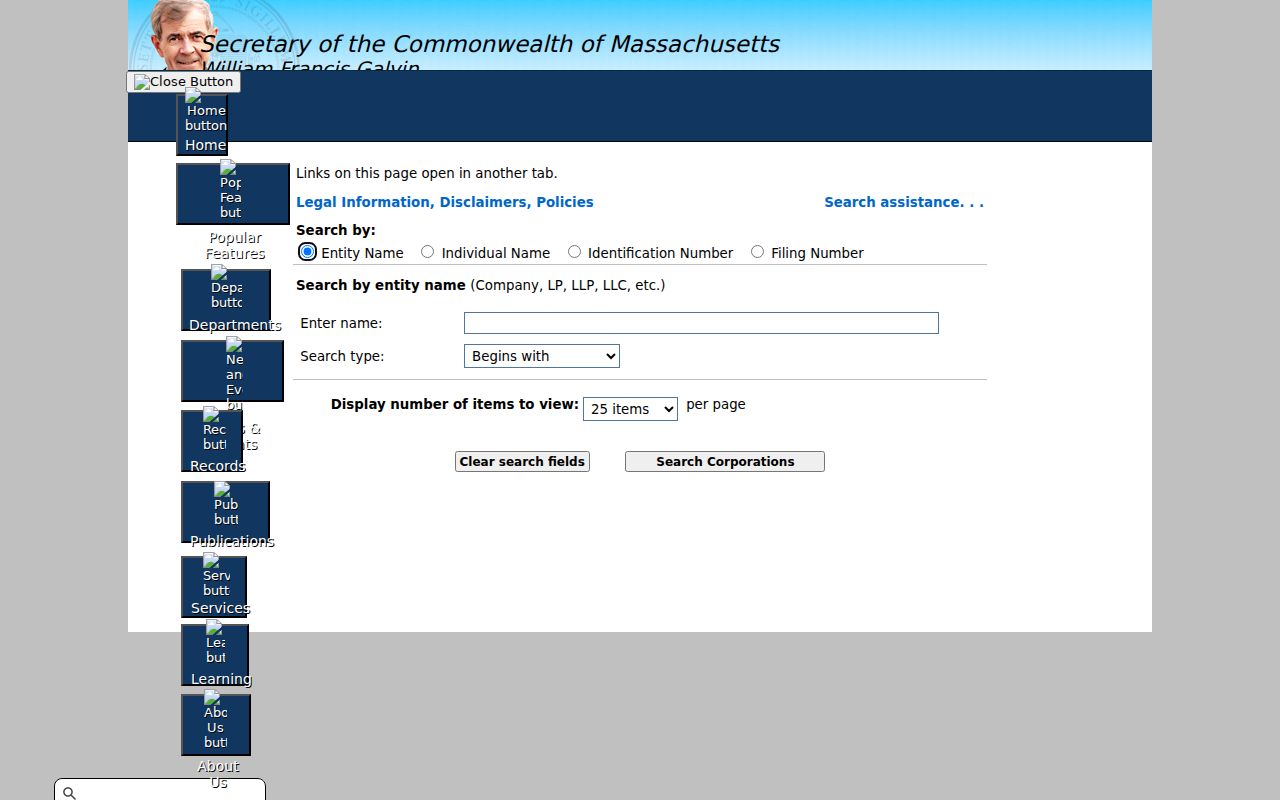
The Massachusetts Corporations search shows its separate search tabs.
The official Massachusetts unclaimed-property search is likewise a bounded owner or heir route.

Both tools should be read for the purpose they were created to serve, not combined into a profile of a person.
Chelmsford Records Use Limits
Public availability has limits. Massachusetts Address Confidentiality Program participants and protected voter records must remain suppressed. Court, vital, and other records may be sealed, impounded, restricted, or incomplete online. Do not try to reverse a substitute address, publish sensitive identifiers, or treat a search gap as a reason to seek private records. The local record trail is for family history, estate and heir questions, civic research, property history, and lawful personal research.
| Official source | Best use | Key limit |
|---|---|---|
| Town or state index | Find a custodian and citation | May omit restricted material |
| Recorded document | Verify a transaction and its date | Does not establish occupancy |
| Historical directory | Place a household in a period | Does not verify current contact |
Use records responsibly. Chelmsford research must not be used to stalk, harass, threaten, monitor, or expose anyone. Protected addresses and confidential records must stay protected.
Note: When a record is withheld, ask the custodian about the lawful access route rather than trying to reconstruct protected information elsewhere.